
Annie had always found lighting stores fascinating as a child.
It was the lone thought piercing her brain as she sunk into the passenger seat of Bret’s car. She stared out the window at the passing landscape. Typical cardboard suburbia; a mixed bag of half-abandoned strip malls, fast-food restaurants and car dealerships. Her dead stare at the scenery echoed the rhythm the tires made as Bret drove.
Thump, thump, thump.
The same, the same, the same.
The drive was as perfunctory as static on a television. They’d traveled the exact stretch of highway many times, and she’d grown numb to the chaos—to the white noise. Ambient comfort. Beige carpeted domesticity, or what passed for it when a person opted for complacency instead of setting the world on fire.
She’d never even had a spark.
Bret drove too fast for her comfort. They’d had more fights than she could count about his habit of speeding up to approach a red light. Annie would argue that if the light was already red, why rush? It seemed counter-productive and borderline stupid, the latter an opinion never voiced. He would argue that she should shut the fuck up and let him drive the car. Then she’d silently wish for his death and they’d repeat the process the next time they were required to drive someplace.
But, she’d always found lighting stores fascinating as a child. Magical. Otherworldly. Annie allowed the memory to wash over her and leaned her head against the side window, forehead resting against the cool glass.
She willed her soul to transcend, escape the godforsaken Toyota Camry deathtrap and the reality of the moment, and press soft palms against storefront window of Long Island Lighting. Absorb the glitter and magic of a hundred chandeliers and lamps, all lit in tandem. She closed her eyes for a moment, and she was inside. A child again, innocent and beautiful and in awe.
Then, as quickly as the moment had come, it was gone. The light turned green, Bret slammed his foot on the gas, and the movement caused her to knock her head on the window.
She swallowed hard. He hadn’t even noticed she’d bumped her head, despite the noise.
They were on their way Michael’s house, one of Bret’s friends from high school, a group of former handball court dirt-bags who hadn’t gone far in life. Michael was a housefly with a hair-trigger, and nasty, especially when liquor was involved. And liquor was always involved. She’d sat through carbon copies of the evening many times. Bret and Michael, and an assortment of other unsavory specimen, would drink themselves into an incoherent stupor. Bret was always the drunkest person at any party, and it was an embarrassment. She’d cleaned up piss and vomit more times than she cared to admit, and more times than any woman in her thirties should do for her not-exactly-boyfriend.
Michael’s wife, Kristen, was nice, but Annie had never heard her make more than the most generic small talk. Annie wasn’t interested anyhow. At her age, she was no longer taking applications for new friends. The books were as closed on this topic as Annie’s heart. On this matter, Bret liked to point out that she was boring, unfriendly, and had an off-putting personality. Annie stayed quiet and retreated into her phone, counting the minutes until she’d drive him to his brother’s apartment, and then take her own car home. Bret made arbitrary rules like “we always take my car” and she had to adhere or contend with his pissy attitude, even though it commenced and extended her evening by at least twenty minutes.
And so they took his car. Every. Single. Time. She accepted it and called it self-preservation. She called it self-care. They were trendy terms and she wasn’t one to skip a bandwagon.
The trek home at the end of an evening, often into the early hours of the next day, was the only part of the night she enjoyed. Bret was always passed out drunk. Once, upon arriving at his brother’s apartment, Annie couldn’t budge him. She’d placed his keys in his back pocket and left him asleep atop crumbled receipts, White Castle wrappers and an assortment of other garbage. He’d never even mentioned the incident. They’d just carried on as if it had been a normal occurrence.
Annie’s favorite part of the drive was the lighting store. Since she was the person behind the wheel, and, for all intents and purposes, alone in the car, she passed the store as slowly as she pleased, took in the golden glow from within, allowed herself to submerge into days past. Once or twice, when Bret’s wet snores indicated that even a collision wouldn’t rouse him, she’d allowed herself the indulgence of pulling into the parking lot. Just for a few moments, she’d tell herself. With the parking lot completely empty, Annie would park the car as close to the front window of the store as possible. Sitting in near-silence, save for the intermittent snoring, she’d exhale and zone out. Or zone in.
She would enter that store.
Not literally, of course. She was not skilled at breaking and entering. Adult Annie wasn’t entering the store on those evenings. Thirty-five-year-old Annie wasn’t the entity walking up and down the aisles, looking in amazement at the massive crystals dripping from the ceiling, like white rain on a summer evening. It was seven-year-old Annie, walking through the store, hand-in-hand with her grandfather, as he shopped for an new sensor light for the driveway or an ornate cover for the light in the hallway. Both versions of Annie appreciated the beauty, though; both were lost in the wonder. But this Annie–she had to return to the reality of dusty LED bulks and blinding kitchen high-hats after the daydream was over. Little Annie could stay in that moment forever if she wanted to.
As an adult, Annie thought about practical matters: How could they afford to leave every light on all night? How large must the electric bill be? But she appreciated the constant luminosity. It was an oasis—glowing amber and golden carnival lanterns in the midst of an unending cycle of disappointment and cracked pavement—her life, her days, nothing more than boxes she would cross off a calendar with a black marker, if she remembered.
Annie hadn’t been inside a lighting store for twenty years, maybe more. She was sure styles and designs evolved, but in her mind’s eye, the interior of this store was a mirror image of what it looked like in her youth. Even then, amid all the beauty, she’d had favorites. Allowed to wander the store, she’d make a beeline for the back, which housed three huge, ornate oil lamps. With nearly three decades between herself and those lamps, she could concede they were gaudy; overdone; an item which might be fit for placement in the house of a mafioso. But, then? She thought they were the most beautiful works of art she had ever seen.
They each featured a central statue, with bars or strings of oil raining around the creature within, like some sort of gilded cage. One had a mermaid as the central figure; one depicted Jesus, with arms outstretched. These were lovely, but they could not compare to the third lamp. The center featured a goddess, beautiful, solitary, and perfect. She was wearing a toga, held against her body with her own left hand. She looked down, either at her feet or toward the circlet of fake flowers which sat near the bottom of the lamp.
Annie’d thought she looked sad. Lonely. She’d silently pleaded with her, tried to convince her to hop onto one of the other lamps and befriend Jesus or the mermaid. She never seemed to notice her entreaties, though. She remained solitary. Annie had thought about poking her tiny fingers through the oil, touching her, offering a measure of comfort.
She never did, though. She was afraid—of consequence, of hot oil, of breaking the beautiful lamp. In the end, she was relegated to stay behind those bars forever. Annie imagined it would sound odd to admit aloud, but she thought of the goddess often. She thought about her as if she were not simply a carved piece of rock, but a living, breathing entity.
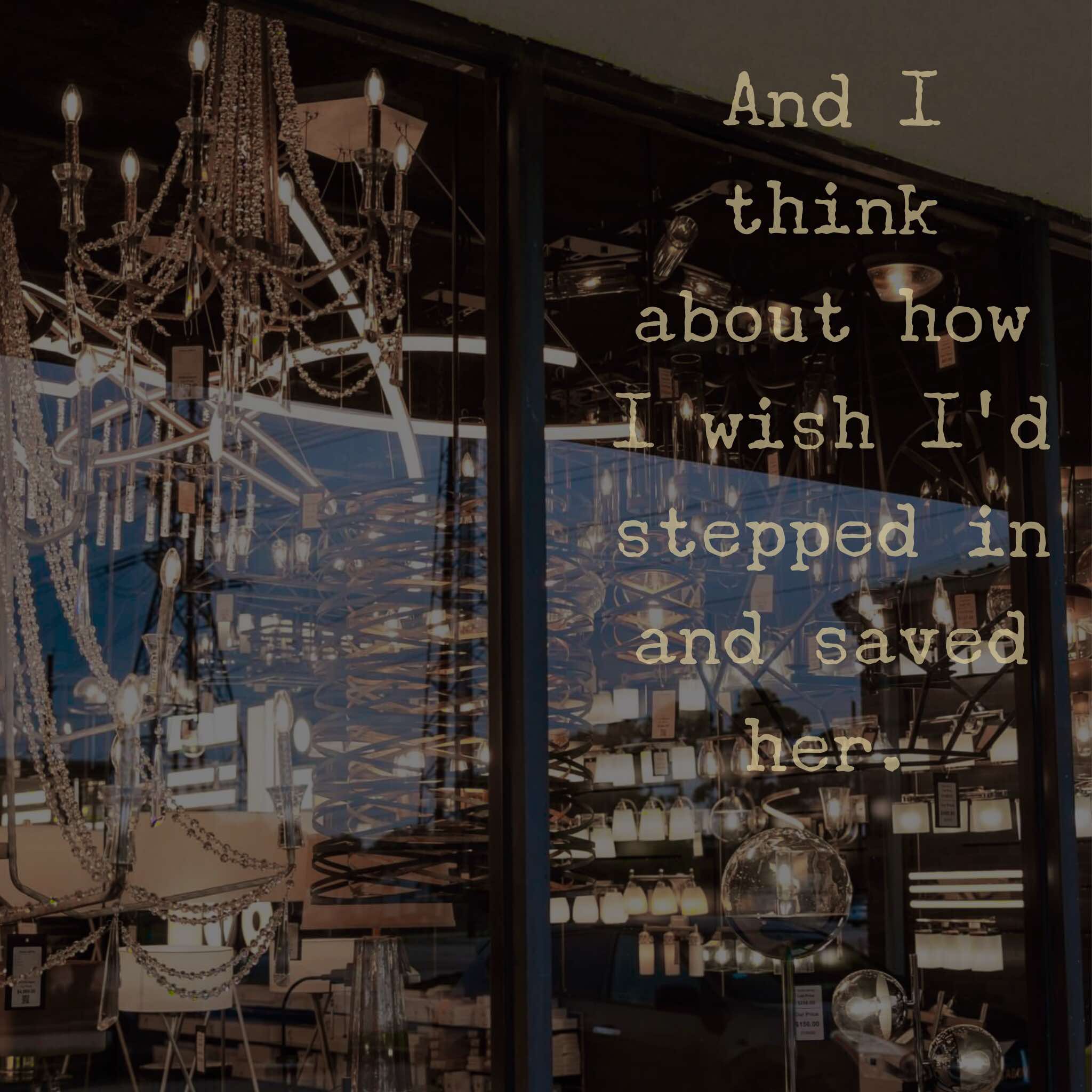
And she thought about how she wish she’d stepped in and saved her.
 Heather-Ann Dunn, Novelist & Poet